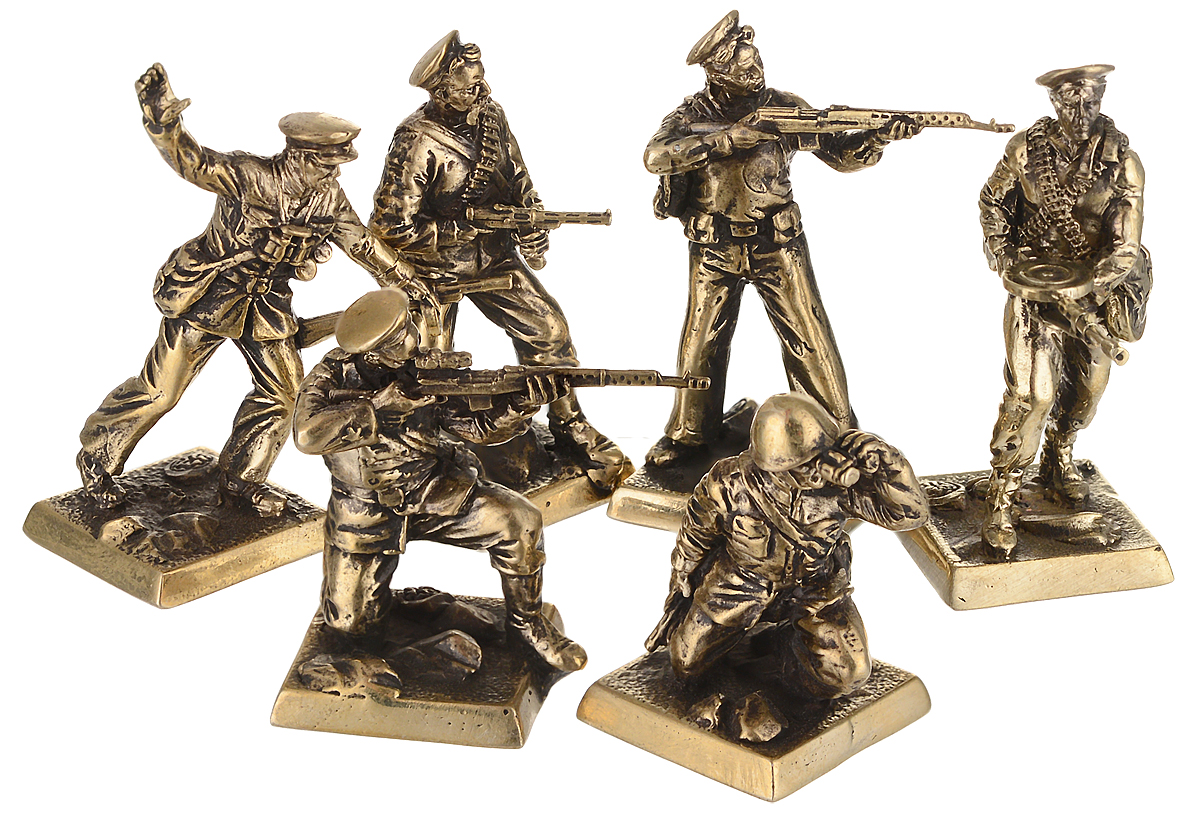
The culture of miniature sculpture in the countries of the former USSR represents a unique synthesis of military-historical reconstruction, art casting, and modern digital communities. In this multifaceted world, the 40mm format holds a special place — a scale that has become a symbol of the transition from a mass children's toy to an elite collector's object. This report is dedicated to studying the genesis of the 40mm metal miniature, its technological features, its influence on collector culture, and the role of modern digital platforms in shaping a new environment of masters and connoisseurs.
Origins and Evolution of the Scale: From Chocolate Eggs to Cabinet Sculpture
The history of the 40mm miniature's popularity in the post-Soviet space is inextricably linked to the tectonic shifts in the culture of consumption and leisure that occurred in the early 1990s. Until that moment, the Soviet toy market was saturated with either plastic soldiers or tin and zinc figures produced by large industrial enterprises. However, it was the appearance of Western brands that formed the standards that today define the appearance of private collections.
The Role of Kinder Surprise in Forming Aesthetic Standards
For millions of children and future collectors, Ferrero chocolate eggs became the entry point into the world of metal miniatures. Metal series like "Landsknechts," "Romans," "Vikings," and "Samurai" were a revelation. Unlike flat or poorly detailed Soviet soldiers, these figures had pronounced volume, the characteristic weight of metal, and a high degree of detailing.
The scale of these figures, which varied between 35–40 mm, de facto set the bar for perception. The collector subconsciously became accustomed to the idea that the figure must fit perfectly in the hand, possess mass, and be made of an alloy imitating a noble patina. It was during this period that the foundations of the exchange culture and the search for "rare" specimens were laid, which later transformed into professional collecting.
Transition to Author's Miniature and Market Formation
As the audience that grew up on "Kinders" matured, a demand arose for more complex and historically accurate works. The mass toy ceased to satisfy aesthetic needs. In response to this, private foundries and independent sculptors began to appear across the CIS. This process coincided with a growing interest in military-historical miniatures (MHM), where the 54mm (1/32) scale had long been the traditional standard.
However, the 40mm (1/45) scale offered a "golden mean." It allowed maintaining details comparable to their larger counterparts, while taking up less space on the shelf and being more affordable in mass casting. This led to the formation of a specific niche — the 40mm metal miniature, which united lovers of history, fantasy, and tabletop games.
Technological Superiority: Materials Science and the Problem of Durability
One of the key factors determining the value of a metal miniature is the material of manufacture. A constant discussion goes on in the professional environment about the advantages of various alloys, where on one side of the scale is traditional tin, and on the other — modern high-tech bronze and brass compositions.
The Phenomenon of "Tin Pest" and Collector Risks
Historically, the "tin soldier" became a metaphor for resilience, but from a chemical point of view, tin is a highly vulnerable metal. The problem lies in the polymorphic transformation of white tin ($\beta$-Sn) into gray tin ($\alpha$-Sn) as the temperature drops. This process, known as "tin pest," is accompanied by an increase in the specific volume of the metal by 25.6%, which leads to the mechanical destruction of the structure.
| Parameter of Physical-Chemical Process | Characteristic of Transformation |
|---|---|
| Process Start Temperature ($\beta \rightarrow \alpha$) | +13.2 °C |
| Temperature of Maximum Destruction Speed | -33 °C |
| Physical Effect | Cracks, conversion of metal to powder |
| Risk for Collections | Irretrievable loss of exhibits upon improper storage |
Historical evidence points to the catastrophic consequences of this phenomenon, such as the demise of Robert Scott's expedition in 1912 due to fuel leakage through crumbled tin seams of canisters. For the collector, this means that items made of pure tin or alloys with its high content (pewter) require strict climate control and cannot be considered eternal in conditions of unstable temperatures.
Bronze, Brass, and Precious Metals: A Guarantee of Eternity
In the modern industry of the 40mm miniature, there is a distinct trend towards the use of copper alloys, primarily yellow bronze and brass. Bronze, an alloy of copper with tin, zinc, or other components, possesses unique properties that make it ideal for sculpture.
First, bronze is absolutely not susceptible to "tin pest." The crystal lattice of copper stabilizes the alloy, preventing allotropic transformations even with extreme cooling. Second, high corrosion resistance allows bronze items to be preserved for millennia. Archaeological finds from the Bronze Age demonstrate the perfect condition of objects that have lain in the soil or under water for more than three thousand years.
Modern craftsmen also actively use the following materials and techniques:
- Yellow Bronze: The primary material for high-quality works, providing a noble color and high casting clarity.
- Brass: An alloy of copper with zinc, possessing a bright golden sheen. Often used for ceremonial series and gift specimens.
- Silver and Silver Plating: Used to create limited collections that have not only artistic but also investment value.
- Gilding: Applying a thin layer of gold to a bronze base allows creating unique cabinet artifacts not susceptible to oxidation.
It is the use of these materials that allows us to assert that modern 40mm miniatures will be preserved in museums and private collections for millennia, becoming a genuine cultural heritage of our era.
Community and the Modern Market: The Role of Social Networks
Social networks, particularly "VKontakte," became the center of life for collectors in the post-Soviet space. A unique ecosystem was formed here, uniting manufacturers, sculptors, and consumers. VK groups have become not just trading platforms, but centers of expertise where subtleties of attribution, restoration methods, and historical authenticity are discussed.
VK Group "Metal Soldier 40mm" (Металлический солдатик 40мм)
This community is the largest information aggregator in this segment. It acts as a virtual club, shaping the tastes of the audience. Group members engage in:
- Cataloging existing and new releases from various workshops.
- Organizing auctions to sell rare and discontinued figures.
- Discussing technical aspects: from metal blackening methods to 3D wax modeling technologies.
The existence of such a community allows masters to receive instant feedback from collectors, promoting the constant growth of product quality. It is also where a secondary market is formed, where the price of rare bronze specimens can exceed their initial value tens of times over.
Five-Fingered Workshop (Мастерская Пятипалого): A Model of Modern Casting Art
One of the most authoritative platforms represented in VK and having a physical presence in St. Petersburg is the "Five-Fingered Workshop." Its activities demonstrate how traditional casting methods integrate into modern pop culture and historical reconstruction.
The workshop's assortment strikes with its diversity and orientation to the relevant demands of collectors. The catalog features both popular media franchise characters and original series.
| Thematic Series / Character | Manufacturing Material | Specificity and Artistic Features |
|---|---|---|
| "Game of Thrones" Universe (Tormund, Sansa, Ygritte) | Yellow Bronze | Portrait resemblance to actors, costume detailing |
| "The Fallen" Series (The Silent, The Howler, The Hanged) | Yellow Bronze | Expressive sculpture, high artistic value |
| Fantasy Setting (Sisters of Battle, Raider on a Bike) | Yellow Bronze | Complex detailing of mechanisms and armor |
The Five-Fingered Workshop sets high quality standards: using only high-quality yellow bronze, careful post-processing of each figure, and attention to details previously available only on the 54mm scale and higher. Prices for their products (from 620 to 2560 rubles) make them accessible to a wide audience while retaining product exclusivity.
The Culture of Collecting: Psychological and Social Aspects
Collecting 40mm metal miniatures is not just the accumulation of objects, but a complex sociocultural practice. It rests upon deep historical traditions laid by the great collectors of the past.
Legacy of the Great Soviet Collectors
In the Soviet Union, collecting toy soldiers was the domain of the intellectual elite, military historians, and engineers. Names such as Mikhail Viktorovich Lyushkovsky, Alexander Ivanovich Lyubimov, and Lev Lvovich Rakov are inscribed in the history of museology.
Mikhail Lyushkovsky, a retired colonel and candidate of military sciences, gathered one of the largest private collections in the world — about 60,000 figures. His approach to the collection was strictly scientific: each figure served as an element for reconstructing specific historical battles. Alexander Lyubimov, possessing a collection of 20,000 items, focused on engineering precision and form diversity.
Modern 40mm miniature collectors inherit this spirit of systematicity. It's important for them not just to own a figure, but to know the character's history, the specifics of their weaponry, or the sculpture's creation context.
The Phenomenon of "Eternal Ownership"
The most important component of collector culture is the realization of the item's durability. In a world of disposable things and digital content, a bronze miniature is perceived as immutable. Collectors frequently note that their collections are an investment in the future, a family relic that won't lose its properties over time.
Bronze figures do not fear moisture, temperature changes (unlike tin), and mechanical damage (unlike resin or plastic). This creates psychological comfort in ownership: the collector knows that even if the figure spends hundreds of years in the earth, a simple cleaning will return it to its pristine appearance. That is why many view the 40mm miniature as a form of "small plastic," comparable in significance to ancient bronze statuettes.
Artistic and Production Standards
Creating a high-quality 40mm miniature is a labor-intensive process requiring the participation of world-class sculptors and experienced casters. Unlike 28mm gaming figures, where a certain grotesqueness of proportions is permitted ("heroic scale" style), realism and anatomical accuracy are valued in the 40mm standard.
Creation Process: From Master-Model to Edition
Modern production includes several stages, each of which is critically important for the final result:
- Creating a master model: Today, this mostly occurs in a digital environment (ZBrush), allowing for microscopic detailing. However, the "old school" still prefers hand-sculpting from special compounds (green stuff, magic sculpt).
- Printing and refinement: The high-resolution 3D-printed model undergoes manual revision by the master sculptor.
- Molding: High-temperature silicones capable of withstanding poured molten bronze or brass are used.
- Casting: Centrifugal casting or pressure die casting is applied, eliminating shells and non-fills on fine details such as character faces or weapon elements.
- Finishing: Each figure passes through the stage of removing sprues, sanding, and, if necessary, patination.
It is during patination that the magic of metal manifests. Chemical blackening followed by polishing of prominent parts gives the figure volume and depth, emphasizing the sculptor's mastery.
Conclusion: The Future of the 40mm Format
Research shows that the 40mm metal miniature across the former USSR has outgrown mere enthusiasm and become a full-fledged direction in modern decorative and applied arts. The combination of historical memory, the technological reliability of bronze alloys, and the activity of digital communities has created conditions for the sustainable development of this field.
Unlike the tin products of the past that are subject to destruction, modern bronze and brass miniatures represent artifacts capable of surviving for millennia. This makes them attractive not only to enthusiasts of military-historical miniatures but also to serious investors and museums.
Workshops, such as the "Five-Fingered Workshop," and specialized groups on social networks continue expanding the boundaries of the genre, integrating new themes — from fantasy to modern pop culture — while maintaining the highest quality standards. Thus, the 40mm metal soldier remains not simply a figurine on a shelf, but the embodiment of tradition's continuity, the triumph of technology, and the inextinguishable human passion for collecting the beautiful.
The creation of such durable objects allows cultural heritage to be preserved for centuries and millennia, and such soldiers may very well stand in the collection of a space ship captain flying to terraform yet another planet in the year 4026.